The CEO Who Said the Quiet Part Out Loud
In early 2024, Jensen Huang, the CEO of NVIDIA (the chipmaker that powers most of the AI revolution), said something at a conference that should have ended the "learn to code" conversation for good.
He said: "It is our job to create computing technology such that nobody has to program. And that the programming language is human." His point was that the skill we have spent the last fifteen years telling kids to invest in (programming) was about to become a skill computers do for humans, not a skill humans do for computers.
He was right. Throughout 2024 and into 2026, junior developer hiring at every major tech company contracted significantly. Computer science enrollment at top universities flatlined. The graduates who did finish CS degrees found themselves competing for fewer jobs against AI tools that could already do most entry-level coding work.
If you are the parent of an eight-to-twelve-year-old today, the "learn to code" advice you've been hearing for a decade is no longer the right answer. The honest question now is: if not coding, then what?
This article is about the skill that actually matters. It is the skill I am specifically writing my books to help parents teach. It is not glamorous. It is not technical. It does not require a single line of Python.
It is the ability to ask better questions.
The skill that will define your kid's career is not the one that's been on every "future of work" list for the last decade.
Why "Learn to Code" Was the Right Advice for Twenty Years
I want to give the previous advice its due before I dismantle it. From roughly 2005 to 2020, telling kids to learn to code was the single best career advice a parent could give. Coders were genuinely scarce. Coding salaries were the highest entry-level salaries in any field. Bootcamps could turn a non-programmer into an employable junior developer in twelve weeks. The pipeline was real.
It was also a beautiful fit for how parents actually want to give career advice. Concrete. Measurable. You could check whether your kid was learning. You could see the lines of code. You could enroll them in a class. You could buy them a book. You could point at a college major and say: do this, and you'll be fine.
The advice produced a generation of working coders who got real jobs and built real things. It was not wrong. It is just no longer right.
What changed is that the work of writing code became a thing AI does well. Not perfectly. Not creatively. But the routine 70% of code that any junior developer used to be paid to write is now writeable by Claude or GPT-5 or any of the other large language models in roughly fifteen seconds. Companies that used to hire ten junior developers now hire two senior developers and a subscription to an AI coding tool.
This is not a temporary dip. The economics will not snap back. The "coder shortage" is over. The next decade belongs to a different skill.
The Actual Skill: Asking Better Questions
The skill that will define your kid's career is the ability to ask better questions of AI.
That sounds soft. It is not. It is the foundational skill of the next twenty years of work, and it has three layers, each one harder than the last.
Layer one: knowing what to ask for. This sounds obvious until you watch a kid (or an adult) try to use ChatGPT for the first time. They ask things like "write me a story" and get a generic story they don't actually want. The skill of being specific about what you want, what context matters, what constraints apply, and what good output looks like is the bedrock skill of the AI era. It is harder than it sounds. Most adults cannot do it well.
Layer two: knowing how to push back. AI gives you an answer. The answer is usually fine. Sometimes the answer is wrong. Sometimes the answer is technically correct but unhelpful. Sometimes the answer is missing the obvious next question. A kid who can look at an AI output and say "no, that's not quite what I meant, what I actually need is..." is a kid who will be able to direct AI for the rest of their working life. A kid who takes the first answer at face value will be replaceable by anyone who can do the same.
Layer three: knowing what to verify. AI is wrong often. Confidently wrong. The verification skill is the ability to look at an AI output and say "I don't trust this part of it, let me check it." This is the highest-order version of the skill, and it is the one that separates kids who use AI well from kids who get fooled by AI.
Asking better questions has three layers. Knowing what to ask for. Knowing how to push back. Knowing what to verify.
These three layers, taken together, are the skill set that replaces "knows how to code" as the new must-have.
Why This Skill Matters More Than Any Specific Technical Skill
A kid who learns Python today is learning a tool that may or may not be useful in 2040. A kid who learns to ask better questions is learning a skill that will be useful in every job, in every field, for the rest of their life.
The kid who knows how to ask better questions can use AI to write code if they need to. They can use AI to write essays, analyze data, plan trips, debug their own thinking. They can use AI to do almost any cognitive task they need to do, faster and better than they could on their own. The specific tool changes; the skill of directing the tool does not.
Compare that to the kid who learned Python in 2018. That kid is now competing for entry-level coding jobs against AI that can write Python better, faster, and for free. Their specific skill became commoditized. The skill of "knowing what to ask for and how to verify the answer" doesn't commoditize. It is, structurally, the skill that controls all the other skills.
This is the framing economists call "complementary capital." When something becomes cheap (in this case, the production of code, text, images, analysis), the things that direct that production become more valuable. The producers get cheaper. The directors get more expensive. Asking better questions is the directorial skill of the next era.
When something becomes cheap, the thing that directs it becomes more valuable.
How to Build This Skill at Home (Starting This Weekend)
Here is what makes this skill especially good news for parents: it does not require any technical setup, any subscription, or any specialized knowledge on your part. You can start building it with your kid this weekend, using nothing you don't already have access to.
The trick is to make AI a thing you do together, with intention, on a real project.
Step one: pick a real thing your kid wants to make or solve. Not a school assignment. Something they actually care about. A custom song using Suno. A poster for their friend's birthday. A research project on whatever animal they're currently obsessed with. The motivation has to be theirs.
Step two: sit down together and let them drive. They open the AI tool. They write the first prompt. You watch. Don't take over. Don't give them the prompt. Let them try.
Step three: when they get a result that's not quite what they wanted, ask them: "What's not right about this?" Not what's wrong. What's not RIGHT. The framing matters. You're teaching them to look at AI output critically, to identify the gap between what they wanted and what they got, and to articulate that gap in words.
Step four: when they articulate the gap, ask them: "How would you ask AI for what you actually wanted?" Now they're rewriting the prompt. Now they're learning the skill.
Step five: when the AI gives them an answer, ask them: "Do you trust this? Why or why not?" Now they're learning verification.
If you do this for thirty minutes once a week, your kid will develop the skill of directing AI faster and better than 95% of the adults in the workforce today. That is not hyperbole. That is what the next ten years are going to look like.
If you do this for thirty minutes once a week, your kid will develop the skill of directing AI faster and better than 95% of the adults in the workforce today.
What This Skill Looks Like in Practice
I want to give you a real picture of what a kid who has this skill looks like, because it is different from what most parents expect.
The kid who has this skill is not a kid who is constantly on AI. They are not a power user. They do not necessarily love technology more than other kids. What distinguishes them is small and quiet.
They get a slightly better answer the first time they ask. They notice when the AI got something wrong before anyone else does. They can tell you, in their own words, what AI is good at and what it is not good at. They use AI for some things and not for others, and they have actual reasons for the line they draw. They are not impressed by AI in the way kids who don't have the skill are impressed. AI is, for them, a tool they direct, not a magic friend who gives them answers.
This kid will not be a coder. This kid might not work in tech at all. But every job this kid ever applies for, in every field, will require them to use AI tools, and they will use them better than the people they're hired with. That is the entire mechanism of how the skill turns into a career advantage.
The job market will not announce that this is the most important skill. It will just quietly, over the next ten years, start preferring people who have it over people who don't. By the time your kid graduates, the divide will be obvious. Right now, while they're eight to twelve, is when you build the skill that matters.
Two Last Things
One. I am not telling you to stop your kid from learning to code if they want to. Coding is still a fun, generative, creative skill that teaches systems thinking. If your kid loves it, support them. The point of this article is not "code is bad." The point is that "learn to code" should no longer be the headline parenting advice for the AI era. The headline advice is "learn to ask better questions."
Two. This is not a one-and-done lesson. The skill of asking better questions develops over years, not weekends. The thirty-minutes-a-week practice I described above is the start. The book I wrote walks parents and kids through ten progressively harder missions that build the skill across an entire workbook arc.
You don't need the book to start tonight. You need to pick a real project your kid cares about, sit next to them, and ask the four questions. That is the entire framework. Everything else is repetition.
Learn to ask better questions. That is the headline advice for the AI era.
Get the Free Family AI Activity Kit
5 hands-on activities you can do with your kid this weekend, each one designed to build the question-asking skill described in this article. No tech expertise needed. Each activity takes 15-30 minutes. Free PDF, delivered instantly.
Get the Activity KitDelivered to your inbox in under a minute. Unsubscribe anytime.
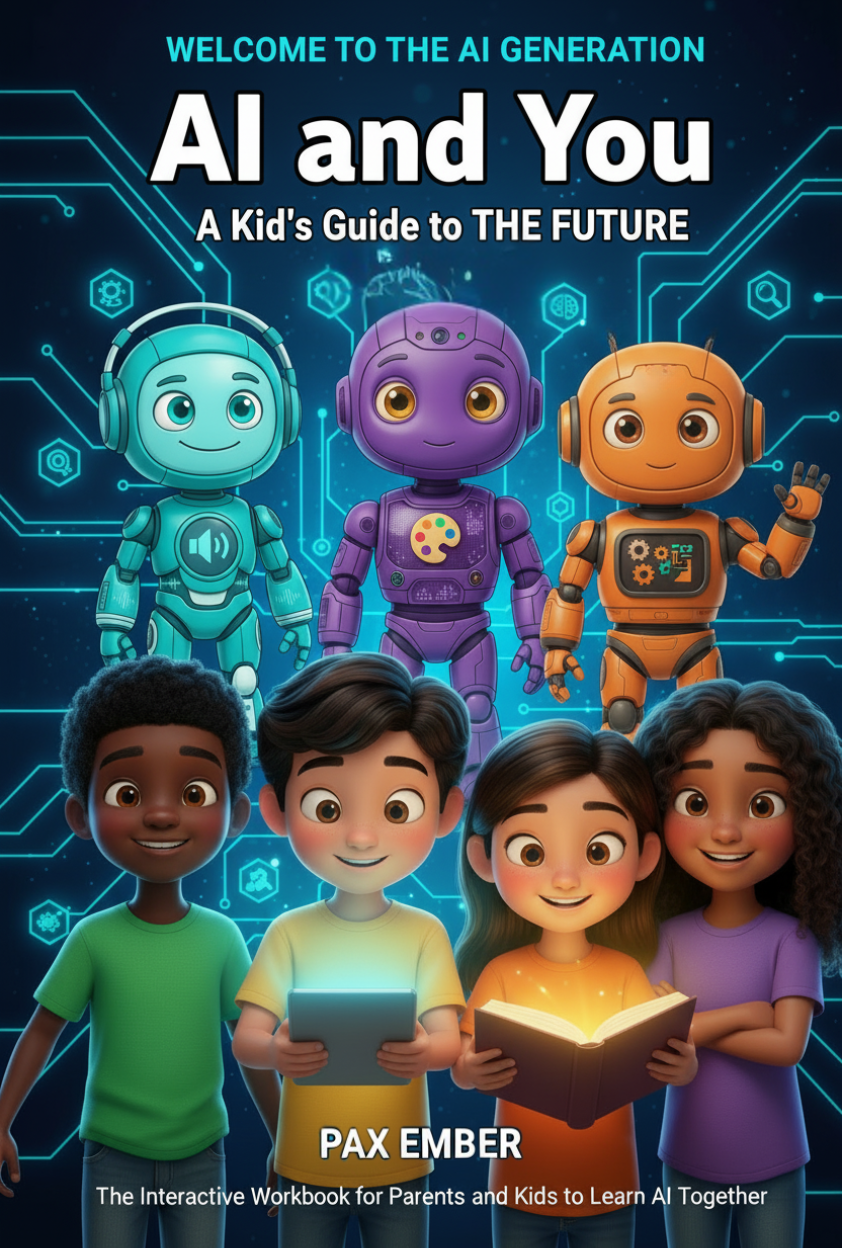
Welcome to the AI Generation: AI and You
The first book in the Pax Ember trilogy. The book builds the foundational skill of asking better questions through ten progressive missions. Trilogy continues with Create with AI (ages 10-11) and Build Your AI Future (ages 12+), launching mid-June 2026.
See the Trilogy