How This Article Started
My daughter Aleithyia was eleven when I started writing about AI for kids. She's thirteen now, and in those two years, AI didn't just enter her life. It rearranged it. Her homework habits changed. Her social conversations changed. The kinds of questions she asked me at the dinner table changed. The book I was writing had to be rewritten twice because the questions she was asking kept moving faster than I could finish chapters.
I could see her becoming someone different. Not worse. Just different. And in a way most parents I've talked to since are seeing too.
I was clumsy with a lot of those moments. I gave half-answers when she asked me hard questions about what AI is. I either over-monitored or under-paid attention. I was, in short, the parent I'm now writing this article to help.
What I've learned, mostly by getting things wrong first, is that the work of parenting a kid through AI doesn't happen in big talks or rule sheets. It happens in three short questions you can ask in five minutes on any given Tuesday night.
These three questions will tell you more about your kid's relationship with AI than any parental control setting, screen-time report, or school newsletter ever will.
They're not tests. They're invitations. And every parent of an eight-to-twelve-year-old should be asking them this week.
The questions aren't tests. They're invitations. The conversation is the point.
Why These Three Questions, Why Now
Here's what changed in the last eighteen months. Your kid is no longer occasionally bumping into AI. Your kid is using AI dozens of times a day, often without realizing it. The autocomplete on their messages. The suggested videos in their feed. The homework helper their friend showed them at recess. The voice that answers when they ask the smart speaker a question they were too embarrassed to ask you.
Recent national surveys consistently find that parents underestimate how often their kids use AI tools, sometimes by half. Common Sense Media's research on teens and generative AI shows the gap clearly: most teens are using these tools regularly, and most parents either don't know or assume their own kid is the exception.
The gap between what kids do with AI and what parents know about it has become the central blind spot of modern parenting. Not because parents are negligent. Because AI is moving faster than school newsletters, faster than parenting books, faster than dinner-table conversation can keep up with.
You can't fix that gap by reading more think pieces. You fix it by asking your kid directly. And the right three questions are the ones that meet your kid where they actually are, not where you imagine they are.
The gap between what kids do with AI and what parents know about it has become the central blind spot of modern parenting.
The three questions below are designed to do three different things. The first opens the door. The second reveals their understanding of their own agency. The third tells you whether they're learning, or whether they're outsourcing their learning. Together they give you a real-time read on how your kid is actually relating to AI, in their words, on their terms.
Ask them this week. Then ask them again next month. The answers will change, and how they change is the most important parenting data you can have.
Question 1: "Show me the last thing AI did for you today."
This is the door-opener. It sounds neutral because it is. You're not asking what they used AI for. You're asking them to show you, which puts the phone or tablet in their hand and the screen in your view at the same time.
What you'll learn from this question depends entirely on how your kid answers it.
If they pull up something they're proud of, an image they generated, a song they made on Suno, a writing assignment AI helped them brainstorm, congratulations. Your kid is in the active relationship with AI that we want them in. They see AI as a tool they direct. They have something to show because they did something with intention.
If they pull up something casual, a TikTok the algorithm picked for them, an answer they got to a homework question, a chat with a friend that had AI suggestions in it, you've just discovered the larger truth about how most kids actually use AI. Most of it is invisible to them. Most of it is happening to them, not directed by them. That's not bad. It's just useful information about where you start.
If they hesitate, can't think of an example, or hand you a vague answer, that's the most important data point of all. It usually means one of two things. Either they're using AI so constantly that they've stopped noticing, the way none of us notice breathing. Or they're using AI for something they don't want to show you. Both are worth knowing about. Neither requires you to overreact in the moment. The point of this question is to get the conversation started, not to win it.
Watch what they pick to show you. Watch the order they think of things in. Watch whether the example they offer is a creation, a consumption, or a shortcut. That's your kid's actual relationship with AI, not the one you've been imagining.
Most of what kids do with AI is invisible to them. Most of it is happening to them, not directed by them.
Parent Script
"That's cool. What made you decide to use AI for that instead of doing it the other way?" Then listen.
Question 2: "What would have happened without it?"
This is the agency question, and it's the one most parents skip.
When your kid shows you something AI did for them, the instinct is to either praise the output ("Wow, that's so creative!") or to worry about the process ("Did you really learn anything?"). Both reactions miss the point. The point is whether your kid has any sense of what AI is doing for them versus what they're doing for themselves.
Try it. After they show you the music they made or the answer they got, ask them: "What would have happened without it? If you couldn't have used AI for this, what would you have done instead?"
You'll get one of three kinds of answers, and each one is meaningful.
The kid who says, "I would have figured it out myself, but it would have taken longer," has a healthy understanding of AI as a time-saver. They know what they're capable of. They know AI is making their work faster, not making them able to do things they couldn't otherwise do. That's the relationship we want.
The kid who says, "I wouldn't have been able to do it at all," has revealed something important. AI isn't a tool for them. It's a substitute for a skill they haven't built yet. That's not necessarily a problem, depending on the task. A ten-year-old shouldn't have to write a complete pop song from scratch to enjoy making one with Suno. But it is information about which muscles aren't getting exercised.
The kid who looks at you blankly and says, "I don't know," has revealed the most. They've never asked themselves the question. The line between what they can do and what AI does for them isn't visible to them yet. Your job here isn't to scold or scare. Your job is to make that line visible. "Let's try it. I want to see what you can do without AI for this kind of thing. We can do it together."
A kid who can't tell you what AI did for them today won't be able to tell you what AI did to them tomorrow.
This question is the difference between raising a kid who uses AI and raising a kid who knows when AI is using them. That distinction will matter more in 2030 than almost any other skill you can teach them now.
Parent Script
"Do you ever try to do this kind of thing without AI, just to see if you still can?" Then listen.
Question 3: "Was that answer actually yours?"
This is the hardest question, and the most important.
It gets at the line between using AI as a helper and using AI as a substitute for your own thinking. It's the question your kid's school is going to start asking them, in some form, within the next two years if it isn't already. It's the question every job they ever apply for is going to be asking, implicitly, by the time they graduate. And the way your kid answers it tonight, sitting on the couch with you, is a small early version of how they'll answer it for the rest of their life.
You ask it gently. You ask it without trapping them. You ask it after they've shown you something AI helped them with, and you ask it like you're genuinely curious, not like you've already decided.
"Was that answer actually yours?"
Here's what makes the question powerful. There's no wrong answer in the moment. If they say "yes, I just used AI to help me word it," that's a real and defensible answer for a lot of contexts. If they say "no, AI did most of it," that's an honest answer that opens the door to the next conversation about when that's okay and when it isn't. If they say "I don't know how to tell," they've handed you the most important parenting opportunity you'll get this year, because that question is the actual question of their generation.
The answer doesn't determine your response. The honesty of the answer does.
What you're trying to build, over time, is a kid who can tell the difference. Who can look at something they made with AI and say with confidence, "the structure is mine, the ideas are mine, AI helped me phrase it better." Or who can say, "I let AI do too much of this one. I want to redo it." That kind of self-awareness is the most valuable thing you can give a kid in 2026. It doesn't come from rules. It comes from being asked, regularly and gently, "was that yours?"
When they get good at answering you, they'll get good at answering themselves. That's the entire point.
When they get good at answering you, they'll get good at answering themselves. That's the entire point.
Parent Script
No script. Just listen, and don't make it weird. The conversation is the point.
What Happens When You Ask These Three Questions Regularly
The three questions take about five minutes. You can ask them at dinner. You can ask them in the car. You can ask them during the commercial break of whatever you're watching together. You don't need a special moment. You need the habit.
Here's what changes when you make these questions a regular thing.
Your kid starts asking themselves the questions before you do. The internal monitor that gets built by being asked "was that yours?" is the same internal monitor that will keep them honest in school, in work, in their own self-image as someone who can do hard things. You're not raising a kid who avoids AI. You're raising a kid who knows what they're doing with it.
You're not raising a kid who avoids AI. You're raising a kid who knows what they're doing with it.
Your relationship with your kid around technology shifts from rule-enforcement to genuine curiosity. They stop hiding things from you because you've shown them you're interested in their answers, not just in catching them. The most powerful tool I've found in years of writing for parents is genuine, non-judgmental interest. These three questions are the cleanest way to deliver it on the topic of AI.
And one more thing. You'll learn what you don't know. The first time Aleithyia explained how Suno actually works, in the level of detail she gave me, I realized she was teaching me something I'd been pretending to know. That kind of role reversal isn't humiliating. It's bonding. Kids love teaching their parents something. Let them.
The most powerful parenting tool around AI is genuine, non-judgmental interest. These three questions are the cleanest way to deliver it.
Start Tonight
Pick one of the three. Ask it before bed. Listen to the answer all the way through, even the parts where your kid trails off or says "I don't know." Tomorrow, ask the next one. The day after, the third.
Then start over. The answers will keep changing, and that's the point. You're not running a one-time audit. You're building a conversation that runs alongside your kid through the most important technological shift of their lifetime.
Five minutes a night. Three questions on rotation. That's the entire framework.
Five minutes a night. Three questions on rotation. That's the entire framework.
If you want to go deeper than what one article can give you, I wrote a full book on this for parents and kids ages 8 to 12 to read together. The book covers what AI actually is, how to use it well, what the warning signs look like when something's gone wrong, and the activities you can do as a family to build AI fluency together. Details below.
But you don't need the book to start tonight. You need the questions. And you need the willingness to listen to whatever your kid tells you.
Get the Free Family AI Safety Guide
The full conversation framework these three questions came from, warning signs to watch for in your kid's AI use, the apps to know about (and which ones to skip entirely), and a printable family agreement you can put on the fridge tonight. 14-page PDF, free.
Get the Safety GuideDelivered to your inbox in under a minute. Unsubscribe anytime.
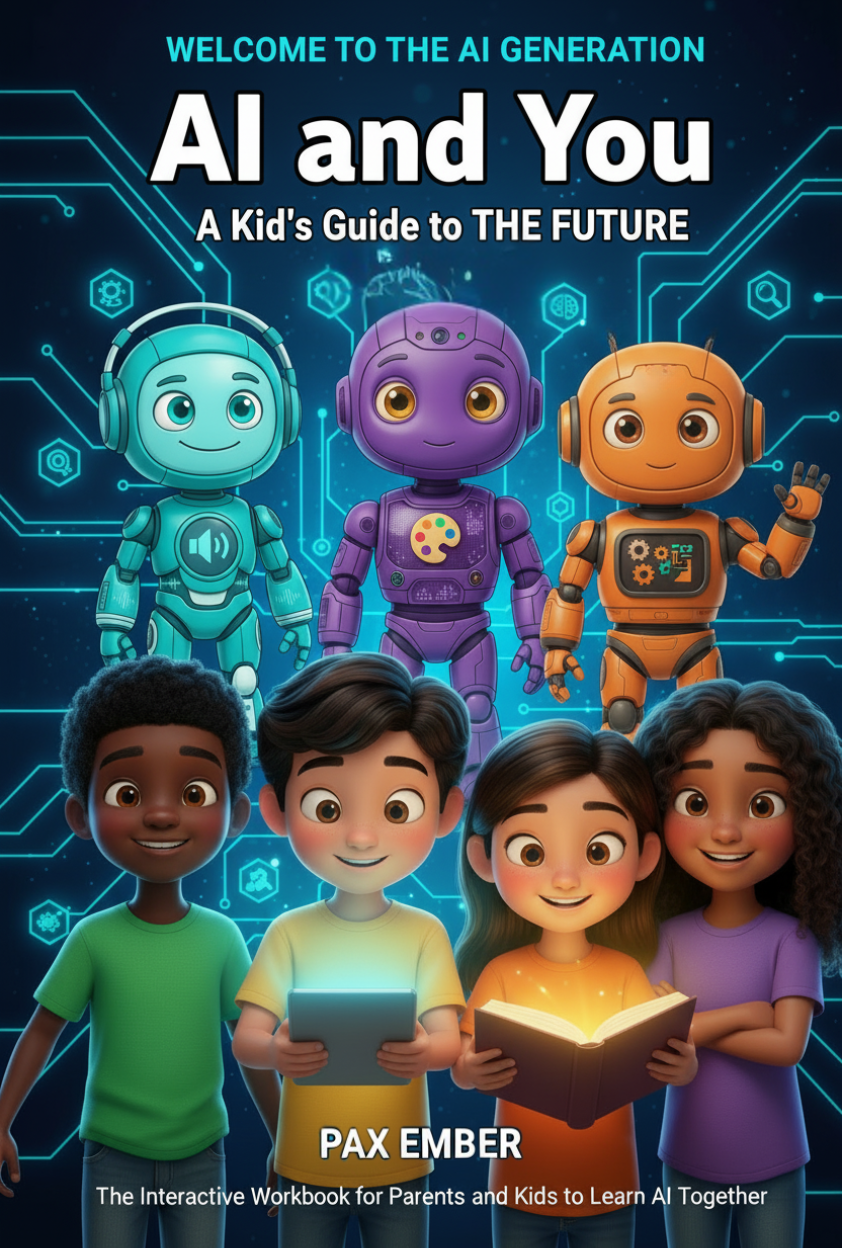
Welcome to the AI Generation: AI and You
The first book in the Pax Ember trilogy. An interactive workbook for parents and kids ages 8 to 12 to build AI literacy together. Ten hands-on missions, parent discussion guides, and three companion AI characters who guide readers through the material.
See the Trilogy