Two Kinds of Kids in the AI Generation
There are two kinds of kids growing up in the AI Generation. Your kid will be one or the other by the time they are fourteen.
The first kind is the driver. They use AI. They direct it. They notice when it appears in their day. They question what it tells them. They create things with it on purpose. They have opinions about which AI tools are good for which jobs. They are not impressed by AI in the way kids who don't have these habits are impressed. AI is, for them, a tool they hold and aim.
The second kind is the passenger. They use AI too, often more than the first kind. But they don't notice they're using it. They take what it says at face value. They consume what it serves them. They ask it to do their homework and accept the answer. They watch what the algorithm picks for them and assume they chose it. They will go through the next decade as the people AI is happening to, not the people who happen with AI.
The difference between these two kids has almost nothing to do with technical skill. It has everything to do with five small habits, built early. This article is the parent's diagnostic for whether your kid is becoming the first kind. If you see most of these signs, you're getting it right. If you don't see them yet, the second half of the article is about what to do.
The difference between an AI driver and an AI passenger has almost nothing to do with technical skill. It has everything to do with five small habits, built early.
I'm going to be specific about each sign so you know exactly what to look for. Then I'm going to be honest about what to do if your kid isn't there yet.
Why "Driver vs Passenger" Is the Right Frame
Before the signs, the frame.
I've spent two years thinking about how to talk to parents about what AI is doing to their kids, and the metaphor that has worked best for me is the car. Every kid in 2026 is going to ride in cars their entire life. The question is whether they will also drive.
A passenger needs the car to work. They need someone else to know the route, to handle the wheel, to make decisions in real time. They are not in danger of getting lost, exactly, but they are also not in control of where they go. Their entire experience of the journey is shaped by someone else's choices.
A driver does not need to know how the engine works. They need to know how to steer, when to brake, what the rules of the road are, how to read the signals around them, and where they want to go. They are in charge of their own journey, even though the car is the one doing the work of moving.
AI is the car. Your kid is going to ride in it constantly. The question is whether they will know how to drive. The five signs below are the five things drivers do that passengers don't.
AI is the car. Your kid is going to ride in it constantly. The question is whether they will know how to drive.
Sign 1 They Notice When AI Appears
The most foundational habit of an AI driver is the ability to notice that AI is in the room.
This sounds obvious until you watch a kid (or an adult) interact with AI without realizing it. The autocomplete that finishes their sentence. The suggested video that the algorithm picked for them. The voice on the smart speaker. The "people you may know" feature. AI is woven into every digital surface your kid touches, and most kids do not consciously register most of it.
A kid who notices is doing something subtle and important. They are tracking which parts of their experience are being shaped by software and which parts are not. That tracking is the first prerequisite for ever choosing differently.
You can test this gently. The next time you're with your kid using a phone or tablet, ask them: "Is there AI involved in what you're doing right now?" A driver will pause and answer thoughtfully, often correctly. A passenger will say "no" without thinking, even when there is.
If your kid notices, they're a driver in the making. The noticing is the muscle every other muscle is built on top of.
The noticing is the muscle every other muscle is built on top of.
Sign 2 They Question What It Says
The second sign is the habit of pushback. Of looking at an AI answer and saying, even silently, "is that right?"
A passenger takes AI answers at face value. The bot said it, so it must be true. A driver runs every AI answer through a quick mental filter: does this match what I already know? Does this seem too clean? Is there a part of this I should double-check?
You can spot this habit in small moments. Your kid does a homework problem with AI help. The AI gives them an answer that's plausible-sounding but actually wrong. Does your kid catch it? Does your kid go look something up to verify? Does your kid say "wait, that doesn't sound right" when the AI offers a confident but suspicious explanation?
If yes, your kid is doing the second-most important thing AI drivers do. They are treating AI as a source that can be wrong, not as an oracle that is always right. That instinct is the difference between a kid who gets fooled by a deepfake in 2030 and a kid who recognizes one before falling for it.
If you don't see this habit yet, you build it the same way you build any critical thinking habit: by asking, gently and often, "do you trust that answer? why or why not?"
Sign 3 They Direct It On Purpose
The third sign is the one most parents miss, because it looks so different from how passengers use AI.
A passenger uses AI reactively. The AI gives them something, and they consume it. They scroll the feed the algorithm picked. They take the answer the chatbot gave. Their use of AI is essentially passive, even though they think they're being active.
A driver uses AI with intention. They open ChatGPT for a specific reason. They give it specific instructions. They redirect it when the first answer isn't what they wanted. They use AI to make something they had already decided to make. The order of operations matters: the kid decides first, AI helps second.
You can spot this in how your kid talks about AI projects. A passenger will say "AI made me a song." A driver will say "I asked AI to make me a song with these specific things, and I tried three different prompts before I got what I wanted." The grammar of the sentence reveals who's holding the steering wheel.
This is the sign that, more than any other, predicts whether your kid will be using AI well in five years or being used by it. The habit of intention is the habit that matters most.
A passenger says "AI made me a song." A driver says "I asked AI to make me a song with these specific things, and I tried three prompts before I got what I wanted."
Sign 4 They Verify Before Trusting
The fourth sign is the verification habit. The thing your kid does after AI gives them an answer, before they act on it.
Verification can be small. A driver who's working on a homework problem with AI will do a quick sanity check: does the answer make sense? Does it match the example in the textbook? Did the AI cite anything I can look up? Verification can also be bigger. A driver who's writing an essay with AI help will fact-check the claims AI makes before submitting.
The point is that there's a step. There's a beat between getting an AI answer and trusting it. A passenger doesn't have the beat. They get the answer and they use it. A driver pauses, asks a verification question, and only then proceeds.
You can build this habit by modeling it. The next time you use AI in front of your kid (and you should, often), narrate the verification step out loud. "Hmm, the AI said this. Let me check it." That out-loud narration is the most powerful teaching tool you have for this specific habit. Your kid will pick up the rhythm before they pick up the reasoning.
Sign 5 They Create With It
The fifth sign is creation. Not consumption. Not assistance. Creation.
A passenger uses AI mostly to consume things AI made. Generated videos in their feed. Generated answers to their questions. Generated music in the background. They are downstream of AI's outputs.
A driver uses AI to make something that did not exist before they decided to make it. A song they thought of. A poster for their friend's birthday. A short story whose plot they invented. A 3D model for a school project. The kid is the source of the idea. AI is the tool that helps the idea become real.
This is the sign that, frankly, makes the case for AI for kids more clearly than any of the others. The kids who are creating with AI right now are doing things that nine-year-olds five years ago could not have done at all. That is real expanded capability. That is what the technology is supposed to do.
If your kid is creating with AI, they are not just using a tool. They are practicing the skill of being a person who makes things. That skill, more than any technical skill, is the one that holds value across every possible future. Makers do well in good economies and bad ones, in stable industries and disrupted ones, in jobs and in their own businesses. AI just gave your kid leverage on that skill that no kid in human history has ever had.
Makers do well in every economy. AI just gave your kid leverage on that skill that no kid in human history has ever had.
What If You Don't See All Five Yet?
I want to be honest. Most parents who read this article will not see all five signs in their kid yet. Three is good. Two is fine. One is a starting point.
The signs are not innate. They are habits you build over months and years, mostly by asking your kid the right questions in the right moments. The questions are simple:
- "Is there AI involved in what you're doing right now?" (builds Sign 1)
- "Do you trust that answer?" (builds Sign 2)
- "What did you ask AI to do?" (builds Sign 3)
- "How do you know that's right?" (builds Sign 4)
- "What are you going to make with it?" (builds Sign 5)
If you ask one of these questions in a relevant moment, three or four times a week, your kid will develop the habits the signs describe. Not because you lectured them. Because the question pulled the habit into existence.
The conversation matters more than the rules. The questions matter more than the answers. The signs are the visible result of habits built one casual interaction at a time.
The conversation matters more than the rules. The questions matter more than the answers.
What This Means About Your Parenting
I want to end with a hard pivot, because this is actually the point.
If you saw three or more of these signs in your kid, congratulations. You are doing something most parents are not. You are raising a kid who will not be replaceable by AI, will not be controlled by AI, and will not be afraid of AI. They will be one of the people who shapes the next twenty years instead of being shaped by them.
That is not a small parenting accomplishment. The signs are visible because the work is invisible. The questions you've been asking, the conversations you've been having, the time you've spent paying attention to what your kid is actually doing on their devices, all of it is showing up as these five habits.
Keep going. The work compounds. By the time your kid is fifteen, the gap between drivers and passengers will be obvious to everyone, and you will be quietly grateful you started building these habits when your kid was young.
If you didn't see all five yet, the gap is still small. Eight to twelve is the perfect age to build the missing habits. The questions in the section above are how. Five minutes a day, three or four times a week, for the next year. That's the entire investment.
The signs are visible because the work is invisible.
Get the Free Family AI Safety Guide
14 pages of the conversation framework that builds these five habits, the warning signs that your kid might be drifting toward passenger mode, and a printable family agreement you can put on the fridge tonight.
Get the Safety GuideDelivered to your inbox in under a minute. Unsubscribe anytime.
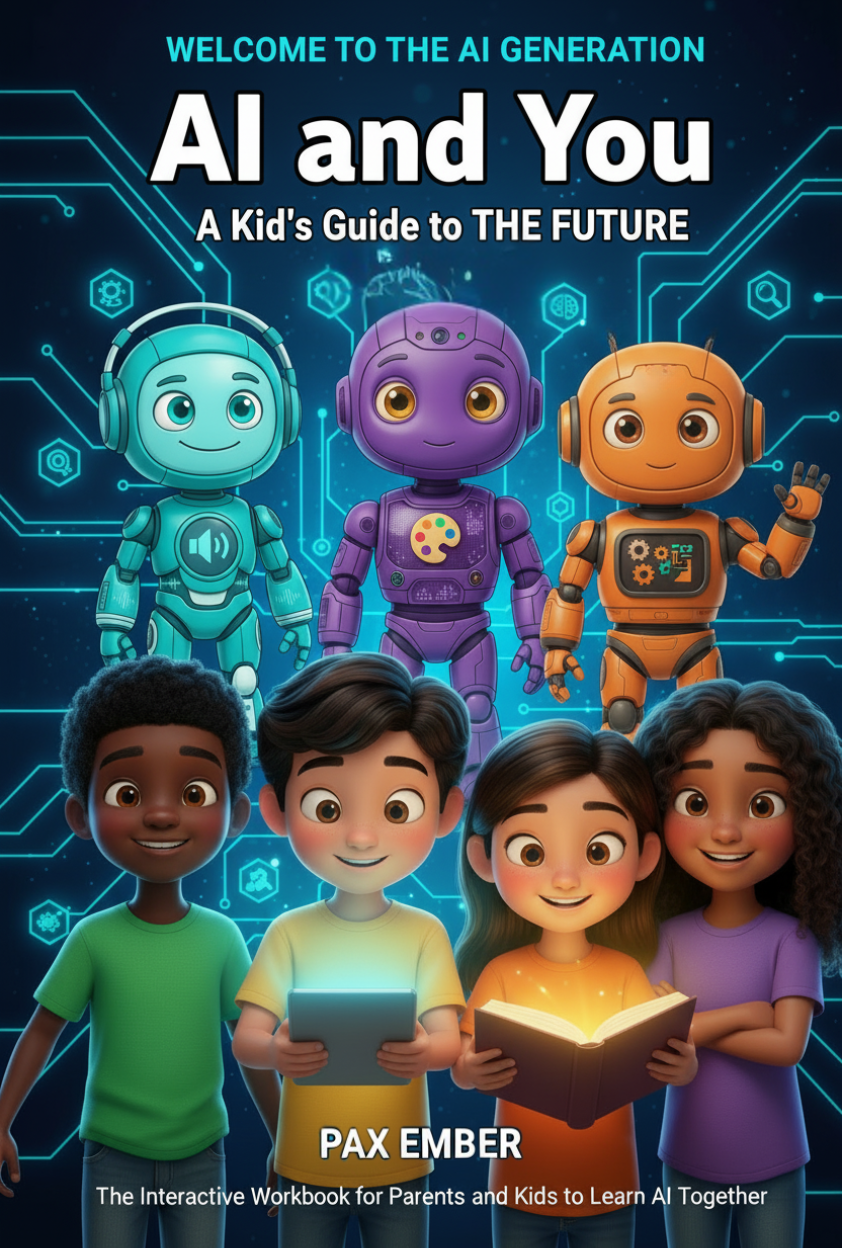
Welcome to the AI Generation: AI and You
The first book in the Pax Ember trilogy. The book builds all five driver habits through ten interactive missions you do as a family. Trilogy continues with Create with AI (ages 10-11) and Build Your AI Future (ages 12+), launching mid-June 2026.
See the Trilogy